
call us today
337-436-6611
Lafayette Train & Railroad Accident Lawyer
Experienced Train & Railroad Accident Attorney in Lafayette
Railroad tracks intersect downtown Lafayette, putting motorists and pedestrians in proximity to large freight trains. Accidents at crossings along Jefferson Street and the Evangeline Thruway corridor can lead to serious injuries in seconds. A Lafayette train & railroad accident lawyer at Cox Law Firm can determine if negligent railroad operations, equipment failure, or another party bears responsibility for the crash.
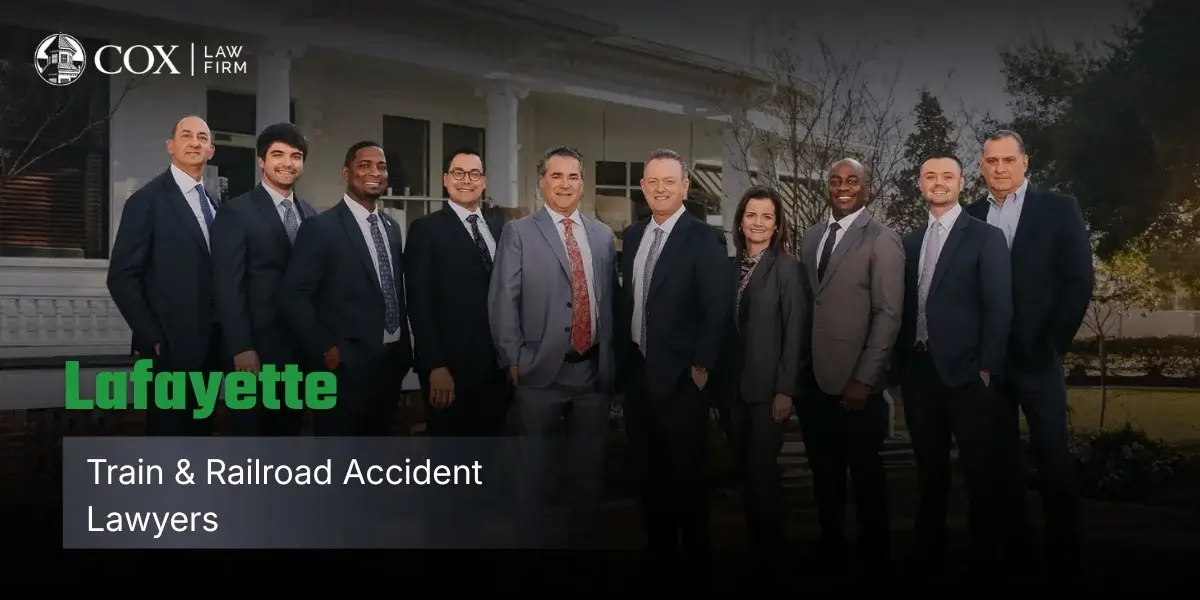
A History of Taking on Powerful Defendants
Cox Law Firm traces its roots back to 1969 when brothers James and William Cox founded it with a core belief that everyday people should have genuine access to justice. Our lawyers provide personal injury representation with 135 years of combined experience. Cox Law Firm has successfully handled complicated litigation against national companies.
Common Causes of Train and Railroad Accidents
Trains can collide with passenger vehicles, passengers on foot, railroad workers, and passengers aboard trains. Understanding the causes of a crash may require analyzing multiple parties’ actions. Some typical examples include:
- Crossing equipment failures. Broken or malfunctioning warning lights, crossing gates, or other safety features could impact a motorist’s ability to know a train is approaching.
- Operator errors. Train operators who speed, become distracted, or fail to follow safety procedures could cause a collision.
- Track defects. Slippery rails, worn-down infrastructure, and lack of rail maintenance could contribute to derailments.
- Obstructed view. Trees, buildings, or parked rail cars could limit drivers’ visibility when approaching a crossing.
- Mechanical defects. Broken brakes, wheels, and other issues can impact train performance.
Railroad tracks crossing roads near downtown Lafayette, and those connecting to Interstate 10, are a couple of areas where vehicle and train traffic meet. Motorists can still cause accidents by speeding, misjudging a distance, or disregarding signals. Not every accident at a railroad crossing is a railroad company’s fault.
The Severity of Railroad Accidents
Collisions at railroad crossings are dangerous. The Federal Railroad Administration’s data reported by Operation Lifesaver shows that 2,268 highway-rail crossing accidents occurred in 2024.
Those collisions caused 259 fatalities and 779 injuries across the country. Data includes accidents at public rail crossings and private railroad companies, not every railroad accident type. Statistics also do not differentiate what percentage of accidents railroad companies were found liable for.
The Federal Railroad Administration identifies accidents at crossings as leading causes of railroad-related deaths. Given this, the significance of well-serviced warning systems and safe practices when crossing tracks is imperative.
Injuries Associated With Railroad Collisions
Railroad collisions can inflict severe injuries. Train vehicles are heavy and build momentum when moving. When trains collide with smaller passenger vehicles, occupants can suffer from traumatic brain injuries, spinal cord injuries, multiple broken bones, and organ damage. Accident victims can sustain life-altering injuries that require lifelong medical care.
Railroad workers can injure themselves through accidents involving train equipment, falling, and exposure to dangerous working conditions. Doctors’ reports can be used to measure the severity of these injuries and estimate their effect on a person’s ability to live as normally as possible and earn a living.
Federal Railroad Accident Laws and Liability
Congress enacted laws and regulations to improve railroad safety and reduce on-the-job hazards for railroad employees. The Federal Railroad Safety Act created a system of federal railroad safety regulation.
Railroad workers may be covered under the Federal Employers’ Liability Act, or FELA. FELA allows qualified railroad employees to file a claim against their employer if negligence contributed to their injury. The railroad accident laws that apply depend on the circumstances of the accident.
Hire a Train & Railroad Accident Lawyer
Train & railroad accident attorneys can help injured parties protect their rights if a railroad company denies responsibility or evidence needs to be preserved through litigation. Lawyers can obtain railroad operating records, review applicable federal safety mandates, consult with railroad engineers, and determine if defective equipment was a factor.
When you hire a train & railroad accident lawyer, they can also help identify liable parties, assess financial damages, and negotiate disputed insurance claims. If your case requires litigation, your lawyer can provide technical evidence and professional witness testimony to prove your train accident claim.
FAQs
Can I File a Claim If I Was Injured as a Passenger on a Train?
Yes, you may be able to file a claim if you were injured as a passenger on a train. Negligent operation, unsafe conditions, or poorly maintained trains can harm passengers, and you may be entitled to compensation if one of these factors caused your injury. The railroad company, a maintenance contractor, and other parties could potentially be at fault, depending on the facts of your accident.
What Happens If a Train Hits My Car at an Ungated Railroad Crossing?
If your car is struck by a train at an ungated crossing, investigators may look into the train’s speed, available warning signs, visibility issues, and any applicable safety standards. Failure to have gates at a crossing does not necessarily prove negligence. If the railroad was responsible for having gates installed but failed to do so, they could potentially be found negligent.
Some railroad crossings lack gates and flashing warning lights, especially in less-populated areas or on rural routes.
Can I Pursue Compensation If a Railroad Accident Involves Hazardous Materials?
You may be able to pursue compensation if a railroad accident involved hazardous materials. Train accidents don’t necessarily need to collide with another object to cause injuries. If hazardous chemicals are released as a result of an accident, anyone exposed to those chemicals could claim injuries. This can include inhalation, skin exposure, and other means.
Can a Railroad Company Be Responsible for Injuries Caused by a Derailment?
Yes, a railroad company may be responsible for injuries caused by a derailment, but only if their negligence caused the accident. Derailments can occur for many reasons, some of which are preventable and could lead to liability for railroad companies. These causes can include negligent maintenance along the tracks or improper train operating procedures. Parts provided by third-party manufacturers can also cause derailments.
Get Legal Help Today
Being injured in a train or railroad accident is a serious matter. A victim can suffer extreme injuries. Cox Law Firm can help you in the legal process so you can focus on recovery. Contact our offices today for the legal help you need.
Request Your
Free Consultation
Fields Marked With An “ * ” Are Required

Cox Law Firm represents individuals injured through the negligence of others in the southwestern Louisiana communities of Lake Charles, Sulphur, Cameron, Jennings, Oberlin, DeRidder, Leesville, Crowley, Oakdale, Eunice, Lake Arthur, Abbeville, DeQuincy and Vinton, and other communities in these parishes: Calcasieu Parish, Jefferson Davis Parish, Vernon Parish, Beauregard Parish, Cameron Parish, Allen Parish, Vermilion Parish, Evangeline Parish, Acadia Parish, Terrebonne Parish and St. Mary Parish.
Office Location
723 Broad Street
Lake Charles, LA 70601
© Copyright 2026 Cox Law Firm. All rights reserved.
Digital Marketing By 
*Images are obtained under license from Canva and other third-party stock image providers, with attribution included where required.